
Impact Door Repair Houston | Fix Dragging Tracks & Rollers

Adil Charahil
On July 19, 2026
Impact Door Repair Houston: How to Fix Dragging Tracks, Failed Rollers, and Humidity Damage on Heavy Patio Doors
Straight talk from a technician who has pulled a lot of rusted rollers out of a lot of Houston tracks. Here is what is actually happening under your door, and what it takes to fix it right.
I’ve been working on doors around this city for a long time, and one thing never stops surprising homeowners: how a door engineered to survive a category three hurricane can still get beat by something as unglamorous as everyday humidity and a few years of daily use. That’s the strange contradiction of an impact rated sliding door here in Houston. The glass and frame are rated to take a two by four launched at over a hundred miles an hour, but the little steel roller carrying that same panel back and forth every day can seize up, rust solid, or grind itself flat in a fraction of that time, simply because it’s living in one of the most humid, corrosive climates in the country.
I get calls about this constantly, and they almost always start the same way. Somebody’s trying to slide their patio door open on a Saturday morning, coffee in one hand, and instead of gliding like it used to, it groans, catches, and needs a hip check to move another six inches. Sometimes it’s dragging hard enough to leave a visible scuff mark on the track. Sometimes it’s popped halfway off the track altogether and now sits at a weird angle nobody wants to look at too closely.
Here’s the thing though. These heavy impact doors are genuinely well built. The glass is thick, the frame is reinforced, and the whole assembly is designed to hold a serious design pressure rating so it can protect your home during hurricane season. But that engineering strength doesn’t do much good if the mechanical parts carrying the weight of that door, the rollers, the track, the alignment of the frame itself, have quietly failed underneath it. A door can be hurricane ready on paper and still be a genuine daily headache, and those two things can compromise each other. A door that’s dragging and not sealing right isn’t doing its actual job when a storm rolls through. That’s what this guide is really about: understanding exactly why Houston does this to sliding doors, and what it takes to fix it the right way instead of fighting it every weekend.
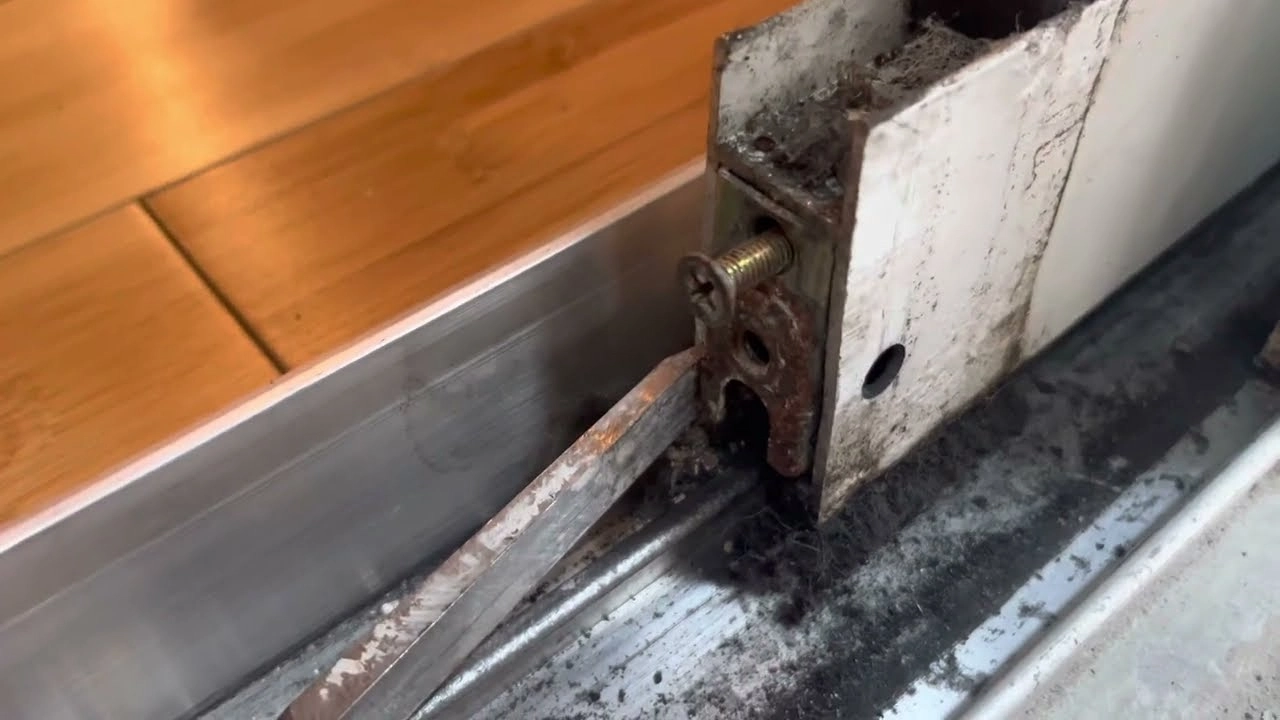
Corroded tandem steel sliding door rollers removed from a Houston Texas patio door track during repair
Section 1: The Rust and Salt Catalyst, Why Houston Rollers Seize Up
Let’s talk about what’s actually happening inside that little roller assembly, because once you understand it, the problem makes a lot more sense.
Every heavy sliding door, impact rated or not, rides on a set of rollers mounted along the bottom of the panel. On a big impact door, we’re usually talking tandem rollers, two wheels working together per bracket, since a single roller couldn’t reliably carry the weight of a thick, impact rated glass panel running into the hundreds of pounds. Those rollers are almost always some flavor of steel, and here’s where Houston’s climate starts working against you before the door’s even out of the box.
A lot of the rollers used in mass produced sliding door hardware are carbon steel, sometimes with a thin zinc or nickel plating meant to buy some corrosion resistance. That plating is fine in a dry climate. It is nowhere near enough for what Houston throws at it. We’ve got relentless relative humidity sitting in the high 70s and 80s for a huge chunk of the year, and depending on how close you are to Galveston Bay, a genuine salt content riding in on that Gulf air. Combine humidity and airborne salt and you get exactly the conditions that accelerate galvanic corrosion, the metal eating itself from the outside in, especially at any point where the plating has even a microscopic scratch exposing the base steel underneath.
Stainless steel rollers hold up dramatically better here, and if you’ve had a door repaired recently and the tech mentioned upgrading to stainless, that’s exactly why. Stainless forms a passive chromium oxide layer that actively resists the oxidation carbon steel just can’t fight off in this environment. It costs more up front, but if you’ve already gone through one or two roller failures on the same door, you already know the real cost of cheaping out the first time around.
Now here’s the part most people don’t think about until they’ve pulled a bad roller apart: it’s not just the wheel itself that fails. The bearing races inside the roller housing, the tiny channels the wheel actually spins within, are also steel, and once moisture works its way into that housing, and it will, those bearings start pitting. A pitted bearing doesn’t roll smoothly anymore. It catches, grinds, and eventually seizes outright, which is exactly when you get a door that won’t budge no matter how hard you push, or one that’s developed a flat spot on the wheel from being dragged instead of rolled.
And that flat spotting is its own problem. Once a roller wheel develops even a small flat section, every revolution after that produces a little thump or click you can hear from across the room. That thumping isn’t just annoying, it’s actively grinding a groove into your track finish every time the door moves, which means even after you replace the roller, a badly worn track can still cause problems for the new hardware if it isn’t addressed at the same time. The track itself, usually an extruded aluminum channel, isn’t immune to this climate either. Salt laden humidity causes its own surface pitting on aluminum over the years, and a pitted track surface creates exactly the kind of rough, uneven friction point that chews through roller wheels faster than they’d normally wear out.
If your patio door has been living out here through a few Houston summers and you’re starting to hear grinding, feel resistance, or notice the door sitting slightly crooked in its track, there’s a good chance you’re looking at exactly this chain: plating breakdown, bearing pitting, flat spotting, and track wear, all feeding into each other. Heavy duty sliding door roller replacement handles this directly, and done right, it includes a real inspection of the track surface too, not just a wheel swap, since a brand new roller in a chewed up track is just setting up the next failure.
Section 2: The Harris County Shift, Foundation Movement and Frame Alignment
Alright, so let’s say the rollers and track are actually in decent shape, but the door is still dragging, still catching, still sitting a little off. This is where I start asking about the foundation, and around here, that question comes up more often than people expect.
Houston and the surrounding areas, whether you’re out in Katy, Sugar Land, Cypress, Spring, or closer in around Memorial and the Heights, sit on a lot of expansive clay soil. That clay does something a lot of homeowners never think about until it causes problems: it swells significantly when it soaks up water during heavy rain events, then shrinks back down during the hot, dry stretches of summer. That’s not a one time thing, it’s a cycle that repeats year after year, and every cycle puts real stress on a home’s foundation.
Even a small amount of foundation movement, and we’re often talking about fractions of an inch here, gets transmitted straight up through the framing into your door opening. A sliding door header, the horizontal piece of framing sitting directly above the door, can start to sag or shift out of plumb as a result. Once that header moves even slightly, the entire door frame is no longer perfectly square, and that’s a real problem for a heavy sliding panel that depends on a level, true track to actually roll smoothly.
Picture it like this: if the track is even a hair out of level, gravity starts working against the rollers on one side of the door more than the other. That uneven load causes accelerated wear on whichever roller is carrying more weight, and it also explains why a door might glide fine for the first foot of travel and then start dragging hard closer to fully open or closed, right where the misalignment is most pronounced. In more serious cases, a door frame that’s shifted enough can let a heavy panel pop partially off its track altogether, one of the more alarming calls we get, since a door hanging half off its track with a big pane of impact glass in it is not something you want to wrestle back into place yourself.
This is also why a door that seemed fine for years can suddenly start acting up after a particularly wet spring or a brutal dry summer. The clay soil cycle doesn’t move at a steady pace, it moves with actual rainfall and drought conditions, so the timeline for when a homeowner notices frame related dragging varies a lot depending on soil composition, drainage around the foundation, and how close mature trees sit to the slab pulling moisture from the ground nearby.
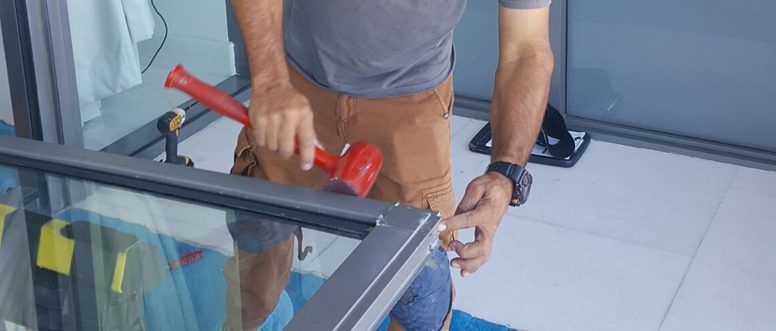
The fix here isn’t always as dramatic as people expect. In a lot of cases, a technician can correct the alignment through careful adjustment of the door’s built in screws, shimming, or resetting the track to compensate for the shift. Full frame replacement only becomes necessary when the movement has cracked the frame material itself or when the opening has gone so far out of square that adjustment alone can’t bring it back to true. An honest technician checks for this before ever recommending a wheel swap on its own, because new rollers in a frame still out of alignment just means you’ll be back to square one within a matter of months.
Section 3: The Hurricane Season Threat, Failed Weatherstripping and Structural Integrity
Here’s where dragging tracks and worn rollers stop being just a comfort issue and start becoming a genuine safety concern, and it’s the part I try hardest to get homeowners to take seriously before storm season, not during it.
Impact rated doors carry a design pressure rating, usually shown as a DP number, reflecting how much wind load and pressure differential the assembly is engineered to withstand during a major storm. That rating assumes the door is functioning exactly as designed: fully seated in its track, properly aligned, and sealing tight against its weatherstripping. A door that’s dragging, sitting crooked, or not closing all the way because the rollers or track have failed isn’t performing anywhere close to its rated design pressure anymore, no matter what the sticker on the frame says. The glass and frame might still be strong enough to resist impact, but if the panel isn’t seated correctly, wind driven rain and pressure can force their way past compromised seals in a way the engineering never accounted for.
Weatherstripping takes its own beating in this climate too. Constant humidity, UV exposure, and heat cycling common through a Houston summer breaks down standard vinyl and foam weatherstripping faster than in milder regions, causing it to compress permanently, crack, or pull away from its channel. Once that seal is compromised, even a door rolling smoothly on the track can still let water force its way in during a serious downpour, since wind driven rain during a tropical storm behaves very differently than a normal rain shower, getting pushed sideways and upward against a door’s weakest sealing points rather than simply falling straight down.
If you’re looking at replacing weatherstripping on an exterior sliding door here, the honest answer is a genuine marine grade or heavy duty silicone based product rather than basic foam strips sold for general use. Silicone resists UV breakdown and humidity related degradation far better than standard foam or vinyl, and on a door already carrying an impact rating, matching it with weatherstripping that can actually survive the same climate just makes sense. This is one of the more overlooked pieces of Houston hurricane prep. Everyone thinks about shutters and generators, but a compromised seal on a sliding door is a real, direct path for wind driven water intrusion during the exact kind of storm that door was supposed to protect against.
This is also exactly why we treat impact door repair Houston service calls as a full system check rather than a single component fix. A door that’s dragging on worn rollers, sitting slightly out of alignment from foundation shift, and sealing poorly due to degraded weatherstripping is dealing with three separate failures that all compound each other, and addressing only one of them going into hurricane season leaves the other two still working against you when it matters most.
Section 4: Step by Step DIY Diagnostic Inspection for Homeowners
Before you call anyone, here are a few quick checks that’ll give a technician a much clearer picture of what’s going on, and honestly, half the time you’ll already know which section of this guide applies to your door.
The Sound Check
- Slide the door open and closed slowly and just listen. A rhythmic thump or click usually means a flat spotted roller wheel.
- A grinding or scraping sound points toward a seized or pitted bearing, or debris built up in a corroded track.
- Total silence with heavy resistance, meaning the door barely moves at all, often means the roller has seized completely and is skidding rather than rolling.
The Dollar Bill Test
- Close the door fully and try slipping a dollar bill between the panel and the frame at several points along the weatherstripping.
- If the bill slides through easily at any point without resistance, that’s a compromised seal at that specific location, and a likely water intrusion point during heavy rain.
- Check all four sides, since a seal can fail unevenly, often worse at the bottom corners where water pools most during a storm.
The Level Alignment Test
- Place a small level along the bottom track and check whether it reads true, or whether one side is noticeably higher or lower than the other.
- Do the same along the top header if you can safely access it, comparing the reading to the bottom track.
- A meaningful difference between the two readings is a strong indicator of foundation related frame shift rather than a simple hardware issue.
Run all three, jot down what you find, and you’ll walk into that service call already knowing whether you’re dealing with roller wear, weatherstripping failure, alignment trouble, or a combination of the three.
Section 5: Clear Cost Metrics, Roller Restoration vs. Multi Thousand Dollar Full Replacement
I’ll be straight with you here, because this is where a lot of homeowners get steered wrong. A full impact rated sliding door replacement, glass, frame, and all, is a serious investment, often running well into the thousands once you factor in the impact glass itself, professional installation, and any structural work needed to reset a shifted opening. If your existing frame is structurally sound, meaning it’s not cracked, rotted, or bent beyond what adjustment can correct, jumping straight to full replacement usually costs a lot more than the actual problem requires.
Targeted roller restoration, meaning a proper roller swap to stainless steel hardware, track resurfacing or cleaning, and alignment correction where needed, runs a small fraction of that cost, and when it’s done right, it restores the door to smooth, reliable operation without touching the expensive impact glass or frame at all. Weatherstripping replacement adds a modest cost on top of that, and it’s honestly one of the best value repairs you can make heading into storm season, given how much protection a proper seal actually provides relative to its price.
Full replacement genuinely is the right call when the frame itself has failed structurally, when repeated roller failures point toward a track damaged beyond resurfacing, or when a homeowner is intentionally upgrading to a higher design pressure rating for better storm protection. But for the majority of dragging, sticking, or noisy patio doors we get called out for across Houston, the honest recommendation is a targeted repair, not a full teardown.
Let’s Get That Door Rolling Right Again
Look, a heavy sliding door that drags, groans, or won’t seal right isn’t just an inconvenience around here, it’s a door that’s not fully doing the job it was engineered for, especially once hurricane season rolls around. The good news is this is a very fixable problem once you know whether you’re dealing with corroded rollers, a shifted frame, worn weatherstripping, or some mix of the three.
If your patio door has been fighting you every time you try to open it, whether you’re out in Pearland, tucked into River Oaks, or anywhere else across Greater Houston, it’s worth getting a real diagnostic before that dragging turns into a bigger problem. Reliable impact door repair Houston homeowners can count on starts with actually figuring out what the climate has done to your specific door, not guessing. If you’d rather have a real technician run the sound check, the dollar bill test, and the level check for you and give it to you straight, that’s exactly what we do every day, and we’d genuinely rather fix the actual problem than sell you a door you don’t need.
Sliding Door Repair Houston
Honest diagnostics, real repairs, storm ready doors
Address: 8202 Worthington Dr, Houston, TX 77083
Phone: +1 281 595 0406
Email: contact@windowsdoorsrepair.com
